Showing posts with label Moss. Show all posts

Sunday, March 11, 2012

Pictures of tiny plants and fungi

Complex thalloid liverwort Marchantia polymorpha at the History Museum:

Marchantia polymorpha at the Shelton History Museum


The cutest little moss I know Grimmia pulvinata at the Cornerstone building


Xanthoria polycarpa at Loop Field


Syntrichia ruralis at the cornerstone building


All rights reserved copywrite 2012

Saturday, February 4, 2012

Dry Creek from the North, with the great scented liverwort

Dendroalsia abietina

Climacium dendroides  moss taking over old lake bed

Rhytidiadelphus moss

Lunch / Dinner at the base of Mount Rose

Large beautiful crustose lichen with snowy mountains in the background

I left my home in at about 10:00am and arrived at the Dry Creek trailhead at about 11PM.  Before I could leave my house I had to put two quarts of oil in my Jeep.  While I was putting oil in my Jeep I noticed that exhaust smoke was coming out from under my Jeep, so looked under it to see what the problem is.  I found that my muffler is cracked in half; I probably caught it on a rock when I was driving over a wash out on the way to the Mildred Lakes trails a few months ago.  I’ll get the muffler fixed later, no big hurry, it’s kind of fun having a Jeep that sounds like a muscle car.   It was a bright sunny winter day but the wind was blowing so the air in town was clean.  The drive to the trail was uneventful other than the sighting of a Springer Spaniel in a car in front of me and a Sherriff jay walking across the freeway in Hoodsport.

Right at the start of my hike I began to recognize some mosses at least to genus.  This is the first time I have hiked here since I started my moss class, and what a difference that class has made already.  I found many of the same mosses that grow in Olympia, but the mosses here were bigger and prettier and better.  The glittering wood moss, or step moss had huge fronds and covered very large areas.   At the base of almost every stream I found the great-scented liverwort.  I was looking for a different liverwort that I have never seen before and I did not find it, but I found many huge patches of the great scented liverwort.  I also saw huge fluffy lumps of the Rhytidiadelphus moss and I think I saw some Dendroalisia moss.  Badge moss was everywhere too along with huge patches of male and female Leucoleptis moss plants.
I saw all the usual lichens, peltigeras, fairy vomits, platismata glaucas, cladonias, ochrolechia and so on.  In one spot the fairy vomit lichen was growing over the top of a porella liverwort.  I found huge pretty crustose lichen on a rock near Lake Cushman; I took several pictures of it with snowy Mount Lincoln in the background.  I also found a few little brown mushrooms and some winter oyster mushrooms that were still hanging on.  I did not see any animal tracks in the snow, but I did see elk scat everywhere.   The ice storm we had two weeks ago must have drove the elk down lower than usual.
The trail was free of snow until 1,500 feet and then there was enough snow to prompt me to put on my gaiters so I could keep the snow out of my boots.  I walked for about 2.5 miles until I reached dry creek.  The creek was low enough to ford today, but I did not cross it, instead I turned around and looked for a lunch spot.  I decided not to eat lunch at the creek because the woods were dark and cold and I wanted to be in the sun. 
I ended up hiking all the way back to Lake Cushman before I had lunch.  The lake level is much lower than it used to be and now one can walk among the stumps of the trees that were cut down before they put in the damn, and mosses have started to colonize the silt and stumps.  I collected two mosses from what used to be the lake bed.  I’m sure that one of the mosses is an aquatic moss.  I don’t know what the other moss is, but it is taking over the entire old lake bed and it is even growing on the old stumps.  This moss does not look like any of the mosses in the nearby forest but I don’t have that good of an eye for moss yet, so this moss could have come from the nearby forest.  I found two old roads under what used to be the lake.  I saw these roads the last time I hiked here too and I thought they were old logging roads.  But now I think they are too narrow to have been old logging roads.  I think they may actually be traces of the original roads that went out to staircase the Mount Rose lodge before the damn was put in.
Some people had been camping on the lake bed when I started my hike but they had left before I got back to my Jeep.  Two other people passed me on the trail, I think this was the first time I have ever seen someone else on this trail, but I don’t normally hike on Saturdays.  The people who passed me were hiking up the trail when I was hiking back down the trail.  I bet they wonder what happened to me since they did not see me on the way out but my Jeep was still at the trail head.  They must have parked next to me at the start of their hike and they must have wondered why my car was still at the trail head when they were done hiking.  I doubt they would have noticed me having my lunch way off the trail. When I got back to my Jeep there was no one parked next to me that is how I know that the people who passed me on the trail had finished their hike before I did.
On the drive out I stopped at Cushman falls to look for liverworts but all I found there was more of the great scented liverwort and not the liverwort I was looking for.  The great scented liverwort only seems to live at the base of year round streams, while the peltigera lichen is happy to grow near seasonal streams or several feet away from year round streams. Whenever I saw a peltigeria I knew that I was looking in the wrong place to find a liverwort.  The peltigera was a brown one and I think it was peltigera mebranacea, I saw a lot of it on this hike.  I think I hiked about 5 miles, my GPS(r) batteries went dead so I don’t have a track log for my exact mileage, but I know that I put 18,884 steps on my daughter’s pokewalker.  I don’t think that pokewalkers are very accurate though.  I got back to my Jeep at about 4:30 and I got home right before it got dark.

8 miles 800 feet elevation gain


Someone's idea of a good place to camp, notice the American Flag

My Jeep

Stupid loud airplanes destroy the experience

Patches playing queen of the hill again but this time on moss

Peltigera membranacea

Isothecium moss with sporphytes and some sweet light

Conocephlum conicum  liverwort with males reproductive organ

Pioneer moss on stump and all over the ground

Hylocominum splendens moss grows very well here

Mystery jelly fungus growing on an alder tree

Menegazzia terabrata  lichen

Conocephalum conicom liverwort

Fairy vomit lichen growing on a liverwort

Lichens and fungus and moss.. OH MY!

Ochrolechia lichen on an Alder tree

Frullania liverwort growing on live alder bark

Thursday, January 12, 2012

Will my moss books ever arrive?


Leucolepis acanthoneuron


I ordered my books on December 23rd, and my credit card was charged on December 28th:
CA NATIVE PLANT SOC 0916 12/28CA NATIVE $144.50. 

But the books have not yet arrived and one of my classmates who did not ordered the books a week later than I did already has his books.  What the hell is going on?

I emailed and asked that question, but in a much nicer way and the response I got was they can't even look at my account to find out where they screwed up until January 17.  Just great...  I wish there was someplace else to order these books from, but there is not.  It looks like I have no chance of getting my required text books until late January.
I tried the get them through the college interlibrary loan and found two of them and ordered them only to get a message saying: We regret that we have been unable to fill your Summit Borrowing Request
for the title listed below.

Even the college bookstore can not get these books or get a reasonable response from the folks sending them.  If I was the author of one of these books I think I'd find a better outlet for selling them..

I'm starting to see moss, I mean I always knew it was there.  This blog was originally called nativemossback at blog spot becuase I'm a local and moss grows everywhere here, even on the backs of locals they say.  But I lost my password for that account soon after I started it.  Then I decided to go with walks with moss and a play on the whole dances with wolves thing.  I wonder if I could even find or figure out how to recover that blog? Oh here it is : http://soggymushrooms.blogspot.com/

I think this is Oregon Beak Moss
But now I am noticing the moss growing next to the lichens and some of it I am beginning to recognize.  I'm surprised at how fast it is happening too.
This blog is a bit messed up with double posts of everything since I deleted mosswalks and then restarted moss walks and reuploaded every thing all in the hope of fixing the search problem with this blog.  Well the search problem is not fixed and now I have two of every post.  I am slowly working my way through deleting the double posts.

I am still feeling ill with some sort of cold that just hangs on, I am also getting manic.  It's tough to fight mania when ill.  I need to go hiking for my mental health but I need to stay home and rest up for my physical health.  So am staying home and obsessing about moss.  There are far worse things to obsess about when manic.  I hope to calm down and get over this cold in time to do some hiking this week.

My class is going to invade the Lower South Fork Skokomish trail.  This will be the third class I have taken that has invaded that trail.  Funny that I've never run into to other classes out there.  Funny how I always end up taking a class that has me hiking in the woods and taking pictures.  I can't believe that I am earning my Upper division science credit by going for hikes and taking picture of moss.  Wow, I'm so lucky!

Wednesday, January 11, 2012

Maybe I don't need a macro lens for moss

I'm having pretty good luck taking pictures of moss with my 50mm prime lens but  it takes a bit of fiddling around and I'm doing it at home.  I'm still glad I have a new waterproof camera on the way though.  I won't have such good luck with my 50mm prime in the woods and certianly not in the rain.  I can always take my moss samples home to get really good pictures of them when it's not raining and the light is right.
I hope my new camera comes before we go to the Hoh.  I'm really dreaded the 3.5 hour ride out there and back.  It's going to be a very long day.  I hope I get to sit next to interesting poeple in the van and I hope we don't get packed in like sardines.  I've never even considered doing the Hoh as a day trip, I don't even go to Quinault for day trips anymore.

I get car sick if I try to read in a car so there won't be much for me to do other than look out the windows and wish I was home with my family or hiking in the Olympics..

Here are my first few experiments in moss photography
Maybe I can be the stephen sharnoff  of  the moss world.  Maybe just maybe there is a niche for moss photographers and I could add to a book someday.
I really want to learn how to use the automontage at the colleg and I'm going to really push to get the training for that this quarter.
Leucolepis acanthoneura

\
Leucolepis acanthoneura  with blanched future stems

Leucolepis acanthoneura


Plagiomnium insigne

Plagiomnium insigne or Badge moss

Thursday, May 15, 2008

How to Remove Moss from Maple Trees


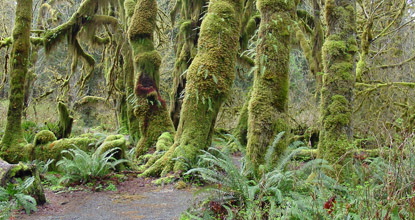
Hoh Rain Forest

I see that people have been coming to this site for advice on  removing moss from maple trees. Please don't remove moss from maple trees. That moss supports many animals and it is good for the trees.  Lichens are often confused for moss and they can pull nitrogen right out of the air. Nitrogen is a very important nutrient for all plant life including your maple trees. Most plants can not pull nitrogen out of the air and they have to get it second hand from lichens and plant such at  Alder Trees. In scientific terms nitrogen is the single largest limiting factor for tree growth in our forests.  When you remove that moss and lichen mat you are actually harming your tree!

From The Daily Astorian

"There’s a large amount of biodiversity up there, with 80 different species of moss found on big leaf maple trees alone. Scientists can look at the reproductive biology of plants, how they pollinate and disperse seeds. They can observe the adaptations animals have evolved, like the skin flaps on gliding lizards or flying squirrels.

There are plants in the top branches of trees that create their own communities, living, dying and decaying in tree branches, and creating an arboreal soil high above the ground that becomes home to earthworms, beetles and bugs."

Finally an old growth forest is far more then just big trees; the amount of moss is also one of the factors that determines what is really old growth.

I admit a bias towards mosses because mushrooms and moss go together! Surface moss holds in soil moisture and provides an ideal habitat for mushrooms.


Importance of Mosses, Lichens, and Liverworts to ONP

Coastal areas from Alaska to northern California, including Olympic National Park (ONP), are home to unique forests often referred to as "temperate rain forests". High annual precipitation and mild winter temperatures in these areas result in immense trees and a lush non-vascular flora. The aesthetic experience of visitors to ONP is strongly influenced by the communities of mosses, lichens and liverworts that drape its tree branches and carpet the ground. These organisms, also called 'non-vascular cryptogams' in reference to their simple structure and small size, contribute significantly to the unique character of the park.


Non-vascular cryptogams have important ecological roles in addition to comprising a significant portion of forest biomass. They influence availability of water by intercepting rainfall and fog, reduce the effects of torrential rain, prolong water input after precipitation has stopped, and maintain high humidity which aids growth of other forest vegetation. They provide shelter and nesting materials for animals and birds, and winter forage for deer and small mammals. Non-vascular cryptogams also have a role in nutrient cycling. Most of their nutrients come from the atmosphere and are subsequently added to the rest of the system either through leaching by rainwater or during decomposition after falling from trees as litter. In some systems the nutrient contribution from non-vascular plant litter fall is comparable to that from all vascular plant litter. A significant source of nitrogen in Olympic forest is litter fall of the nitrogen fixing lichen Lobaria oregana.

Lichens, mosses and liverworts also have great potential as indicators for long-term ecological monitoring. They have no protective cuticle so they cannot regulate gain and loss of water. Daily drying and wetting cycles concentrate chemicals and pollutants dissolved in rain, fog, or dust in their tissues. These may include sulfur, nitrogen, metals, radioactivity, and pesticides. Hence, tissues of these organisms have been sampled for decades as indicators of air pollution. If pollution is high enough, the lichens and mosses themselves may disappear. Measurements showing changes in abundance then become important assessment tools for pollution damage. Similarly, some ground dwelling cryptogams are good indicators of soil conditions because they indiscriminately absorb chemicals dissolved in the soil solution.


Consequently, ONP is concerned about the conservation of mosses, lichens and liverworts for many reasons. They are obviously an important aesthetic and functional part of park ecosystems, they are susceptible to changes in air quality, precipitation chemistry and climate, and some species are extremely rare. They are also of management concern because they are illegally harvested from the park in increasing amounts for sale to the floral industry.